

Tongue Cancer Exercises: Improving Swallowing and Tongue Mobility
May 05, 2026Did you know that moving your tongue early can help improve your speech and your swallow? After treatment, your tongue might feel like it is fighting, but we want to fight back!
Many patients find that after surgery or radiation, their tongue feels short, stiff, or hard to control. This makes eating a chore and talking feel like hard work.
We understand that dealing with cancer is a heavy emotional load. It is normal to feel frustrated when your body doesn't move the way it used to. Please know that you are not alone in this struggle, and your feelings are a valid part of your journey.
With our team we work together every day to help people just like you regain their function. We have seen how small, daily habits lead to big changes in how you eat and speak.
Why Early Muscle Activity is Your Best Tool
When you go through radiation or surgery, your body creates scar tissue. In the medical world, we call this fibrosis. Think of it like a rubber band that has become dry and tight. If you don't stretch it, it stays tight and might even snap or stop moving.
Starting tongue cancer exercises early helps keep those "rubber bands" (your muscle fibers) flexible. By moving now, you are telling your body that you intend to keep your range of motion. This isn't just about "working out"; it is about protecting your ability to enjoy a meal with your family.
When you move your tongue, you also help your body clear out swelling. This is called lymphatic drainage. By simply sticking your tongue out, you are helping your body's natural "drainage system" work better, which reduces that heavy, full feeling in your mouth.
As you move forward, we want to focus on "managing" your tongue health rather than just waiting for a quick fix. Managing your condition means taking active steps every day to ensure you can swallow safely and speak clearly.
This mindset shift helps reduce the anxiety of waiting for "perfection." Instead, you focus on what you can control today. Each exercise you do is a victory for your independence and your quality of life.
Exercise 1: Tongue protrusion
After head and neck cancer treatment, your tongue may feel shorter, stiffer, or harder to control as though it is being held back. Swallowing takes more effort. Food lingers after you think you have swallowed. These are signs that the tongue's mobility and strength have been affected by radiation fibrosis or surgical changes.Tongue protrusion is the foundational exercise that directly addresses this and starting early matters enormously.
Why this exercise matters and what it does to your muscles
Radiation to the head and neck progressively shortens and stiffens the tongue's muscle fibers through a process called fibrosis the same process that causes jaw stiffness. Without regular stretching, the tongue gradually loses its range of movement over months and years after treatment.
Tongue protrusion works by activating the genioglossus, the primary muscle that pulls your tongue forward. Sticking your tongue out consistently and fully maintains muscle length, prevents fiber shortening, and retrains midline control so your tongue moves straight rather than drifting to one side. It also physically stimulates lymphatic drainage in the tongue and floor of the mouth, a clinically valuable secondary effect that reduces swelling and tissue stagnation.
Who this exercise is for
This exercise is recommended if you are experiencing:
- Swallowing difficulties: needing more swallows than usual to clear food
- Tongue weakness, stiffness or reduced mobility following radiation
- Recovery from surgery that affected the tongue or floor of the mouth
How to do it (step by step)
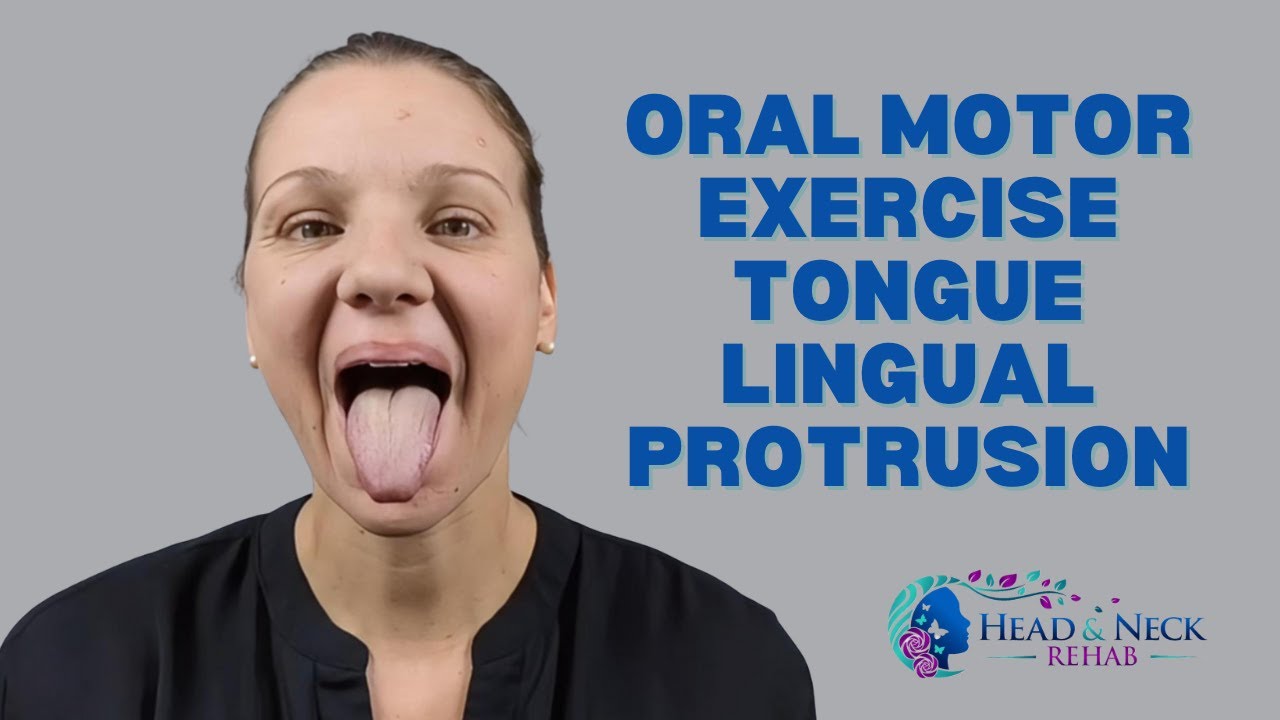
Step 1: Open your mouth comfortably. Allow your jaw to drop to a relaxed, natural open position. Do not force it wide.
( Starting from a relaxed jaw position ensures the tongue can move freely without compensation from the jaw muscles. Check in your mirror. Your jaw should look relaxed, not strained.)
Step 2: Stick your tongue straight out. Extend your tongue directly forward, keeping it centered not drifting left or right. Hold for a few seconds.
( Forward protrusion creates a sustained low-load stretch on the tongue's muscle fibres. precisely the type of force that prevents fibrosis from advancing. Imagine trying to touch the tip of an imaginary pencil held directly in front of your mouth. Straight, forward, centred. Watch in your mirror. The tip of your tongue should point directly ahead. If it drifts to one side, the opposite side is weaker . this is your focus area.)
Step 3: Relax and return. Bring your tongue back to its natural resting position. Pause. Repeat as directed by your clinician.
( Work gradually to extend your tongue further with each session. Even a few millimeters of additional extension is meaningful progress.)
Progression ( how to advance over time )
- Assisted protrusion: use clean gauze to gently pull your tongue forward if active movement is very limited
- Active protrusion: stick your tongue out as far as possible without any assistance
- Resistance: press the tip of your tongue against a spoon or tongue depressor as you protrude, pushing outward against the tool
- Tongue trainer: use a specialized tool if recommended by your clinician for progressive resistance
How you will know it is working
- Your tongue extends further past your lips than when you started
- The tip stays centred without drifting to one side
- You need fewer swallows to clear a mouthful of food
- Swallowing feels less effortful over time
|
Common mistakes - read this before you start
|
Adapting to your treatment phase
Before treatment: Establish your baseline, how far does your tongue extend and how centred is the movement? This gives you and your clinician a clear before-and-after reference point.
During radiation: Frequent, gentle repetitions are more important during this phase than maximum extension. You are preventing fibrosis from progressing, not pushing through it. Even short protrusions performed consistently throughout the day are clinically valuable.
After treatment: Shift focus to rebuilding strength using the resistance stages above. This is when extension and power both become targets.
Watch the practical demonstration now ! Tongue Lingual Protrusion
|
Stop and contact your clinician if you experience:
|
|
Build it into your day - your habit plan
Your action step for today: stand in front of a mirror and stick your tongue out as far as you can. Note whether it goes straight. That observation is step one of your recovery. |
Exercise 2: Resisted tongue protrusion (lingual tongue depressor resistance)
If you have been practicing tongue protrusion and your range of movement has stabilized, this is your next step. Maintaining range is one goal, building the power to use that range safely and effectively during swallowing is another. This exercise is the strength training version of tongue protrusion, and it is the direct bridge between restored mobility and restored function.
|
How this exercise relates to the previous one
You need both. Range without power is not enough for eating. Start with first Exercise, then add this one when you are ready. |
Why this exercise matters and what it does to your muscles
Swallowing requires your tongue to generate significant pressure. it must push food backward with enough force to trigger the swallowing reflex safely and completely. After radiation or surgery, the tongue's muscle fibers weaken and lose their capacity to generate this force, even when range of movement is preserved.
Adding an external load to tongue protrusion, pressing against a tongue depressor or the back of a spoon, is the same principle as resistance training for any other muscle. The tongue pushes against the load, the muscle fibers are forced to contract more powerfully, and over repeated sessions, strength increases progressively. This directly translates to safer, more efficient swallowing and clearer speech.
Who this exercise is for
This exercise is the appropriate next step if you:
- Have established basic tongue protrusion range and are ready to progress
- Are experiencing swallowing difficulties, food requiring multiple swallows, residue in the throat after eating
- Notice that speech is effortful or unclear despite reasonable tongue mobility.
- Are in the post-treatment recovery phase and rebuilding functional swallowing capacity.
How to do it (step by step)

Step 1: Sit upright and open your mouth. Find a comfortable sitting position with your back supported. Open your mouth to a relaxed, natural position.
( Upright posture aligns the tongue with its full range of forward movement and ensures the exercise does not create unnecessary strain on the neck. Sit at a table or in a chair with back support. Do not perform this exercise lying down.)
Step 2: Stick your tongue straight out. Protrude your tongue forward, keeping it centered, the same starting movement as first exercise .
( Check your mirror. Straight and centered before you add any resistance.)
Step 3: Place the tongue depressor at the tip of your tongue. Position the depressor on the outside of your tongue tip. do not place it inside your mouth.
( The depressor sits at the tongue tip and acts as the resistance load. Your tongue pushes forward against it; your hand holds it steady. Think of it like pressing your hand against a wall , the wall does not move, but your muscles are working hard against it. The depressor is your wall. If a tongue depressor is not available, the back of a clean spoon works well as a substitute. )
Step 4: Push forward against the depressor. Press your tongue firmly forward against the depressor while holding it steady with your hand. Hold the push for a few seconds. Breathe normally throughout. do not hold your breath.
( The sustained push against resistance is the training stimulus. The longer and harder the push - within comfortable limits - the greater the strength adaptation over time. You should feel the effort deep in your tongue, not in your jaw. The sensation is similar to pressing your tongue firmly against the roof of your mouth. The depressor should require genuine effort to keep still. If it is too easy, you are not pushing hard enough. )
Step 5: Relax and return. Release the push, bring your tongue back to rest, and pause before the next repetition. Perform 10 repetitions per set as directed.
Progression ( how to advance over time )
- Light resistance: just enough to feel the tongue muscle working
- Gradually increase the force of your push over sessions
- Extend the hold duration: from 2–3 seconds up to 5–10 seconds as strength builds
- Increase frequency: progress to multiple sets throughout the day
How you will know it is working
- The depressor requires noticeably more effort to hold steady than when you started. this is measurable progress
- Speech becomes clearer and requires less effort
- You can prepare and swallow food more quickly, with fewer swallows needed to clear a mouthful
- Swallowing feels safer and more controlled
|
Common mistakes - read this before you start
|
Adapting to your treatment phase
During active treatment: This exercise is generally appropriate post-treatment . Check with your clinician before adding resistance during active radiation.
After treatment: This is your primary strength rebuilding tool. Progress through the stages above at the pace your body allows. There is no fixed timeline. consistent effort over weeks and months produces the results.
Watch the practical demonstration now ! Lingual Tongue Depressor Resistance
|
Stop and contact your clinician if you experience:
|
|
Build it into your day - your habit plan
Your action step for today: find a clean spoon. Sit upright, stick your tongue out, and press the back of the spoon against the tip. Push against it for a count of three. That is your first resisted repetition. |
If you’re ready to take the next step in your recovery, you don’t have to do it alone. Book a call with Lauren Meffen to create a personalized plan and start rebuilding strength, movement, and confidence. https://clarity.fm/laurenmeffen
Stay connected with news and updates!
Join our mailing list to receive the latest news and updates from our team.
Don't worry, your information will not be shared.
We hate SPAM. We will never sell your information, for any reason.